Wire the method into your store
The kit you build the book's loop and four safeguards into a store with: prompts you can stop, checklists before every write, backup and rollback templates, context-file templates, and setup guides. You paste the text into your agent, run it, keep the store intact.
Six parts, all usable
No theory. Each part is text or a template you paste into your agent today. Together they force the agent to explore before it plans, stop at the confirm gate, back up before the write, and report so you find the trail later.
Explore → plan → confirm → execute → report, written so you paste it into your own agent and run. The agent is forced to explore before it plans and to stop at the confirm gate.
One per rule: back up before the write, confirm, verify after, rollback. You run them before the agent touches the store.
Templates that make the agent fetch the changing fields before the write and write them back if the run goes wrong. Rollback isn't from memory.
A shape that forces the plan to be concrete (which products, which source, which rule) and the report to be findable: what changed, what was skipped, how to undo it.
Ready templates for the store's memory: a CLAUDE.md, the store context, and the brand voice, so the agent reads the store's real values instead of inventing them. This is the difference between a working result and a plausibly wrong one.
Step-by-step guides for wiring your agent into Shopify or WooCommerce with least-privilege tokens, plus the companion plugins that open the store to the agent safely. You don't start from a blank page.
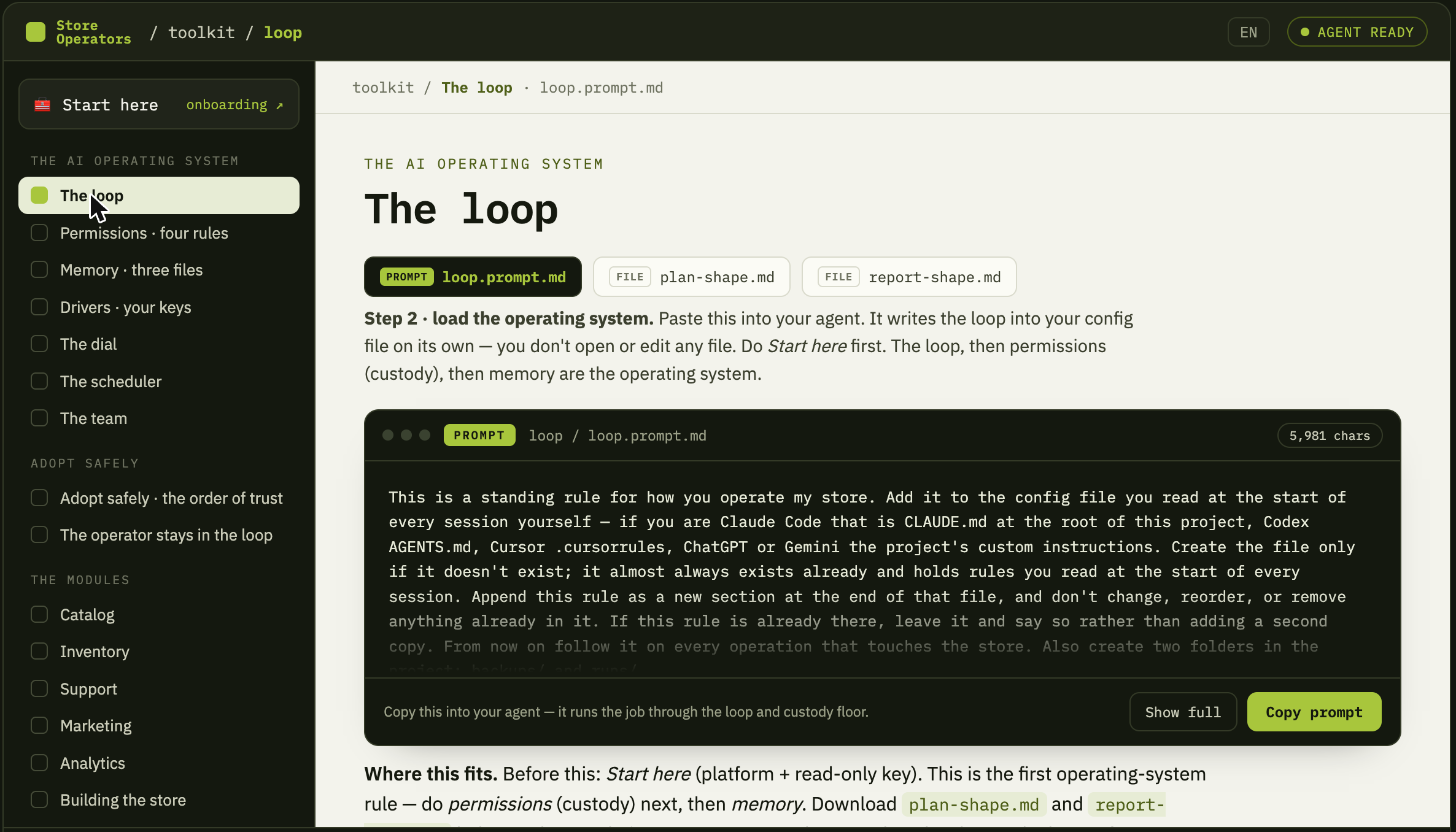
The operating system, in your agent
The toolkit isn't a pile of prompts. It's a whole operating system for a store: the loop, custody, the store's memory and the autonomy dial, written so you get them into your own agent in an hour, not a month.
The system
The layer underneath everything, the same for every store.
- ·the loop: explore → plan → confirm → execute → report
- ·custody: backup, confirm, verify, rollback
- ·the store's memory, the autonomy dial, the scheduler
The modules
The real jobs of a store, run on top of the system.
- +catalog, merchandising, inventory
- +orders, support, returns
- +marketing, analytics, being found by AI
A playbook from a near-miss
These prompts and checklists aren't theory. They are the safety layer I built after I nearly wrecked a client's live store theme with no backup.
In 2025 I set an agent a small job on a client's live store: add one feature to the theme. I wrote the prompt in a hurry and left the agent running on its own. I saw it start writing to the theme and head the wrong way. Had I let it finish, it would have rewritten the core files of a live store's theme, and I had nothing to put them back: no backup, no snapshot, no rollback path. I hit escape in time. Nothing broke. What saved that store was a reflex and some luck, not a method.
That morning is why this exists. The loop, the backup rules, the confirm gate and the rollback path are the safety layer I built afterward, so it could never again come down to luck and reflex.
Without the playbook it cuts corners
You can write the prompts yourself. Plenty do, and the agent runs without the explore step, invents the missing values plausibly, writes outside scope, and nothing tells you what it changed. The toolkit is those prompts already thought through: each with a safety line, a fill gate and a backup before the write.
“Fluent garbage is the danger of every catalog job that touches text: an agent that would rather write something confident than admit it doesn't know.”
€29 against the hours you'd spend tuning prompts, and the one batch you'd unpick by hand when the agent wrote to the wrong field with no backup.
Buy it, or unlock it
The toolkit is €29. If you bought the book, it's free: unlock it with the code on the back of the book.
One payment, no subscription. You get the whole toolkit in your inbox right away.
If you haven't taken the free course yet, start there. It shows the method the toolkit puts to work, and it's free. The book explains it in full.
Common questions
A set of prompts, checklists, context templates and setup guides you paste into your own AI agent (Claude, ChatGPT). No app to install, just text and templates you copy and run.
Because these prompts force the explore step, the confirm gate and a backup before the write. A free prompt runs before it looks. The difference shows up on the first batch you'd otherwise unpick by hand.
No. The toolkit works on its own. The book (€49) includes the toolkit and explains the reasoning behind every prompt, which is why the book is the cheaper way to get both.
Unlock it free: enter your email and the code on the back of the book below. You don't pay twice.
With Claude and ChatGPT, and Gemini too. The prompts are plain text, not tied to one tool.
A one-off €29. No subscription. You get the whole toolkit in your inbox right away.
The toolkit comes free with the book
The book (€49) includes the toolkit and explains the reasoning behind every prompt. The free course shows the method before you buy anything.