The store an agent runs
The AI-Run Store · The AI Operating System for E-commerce Stores
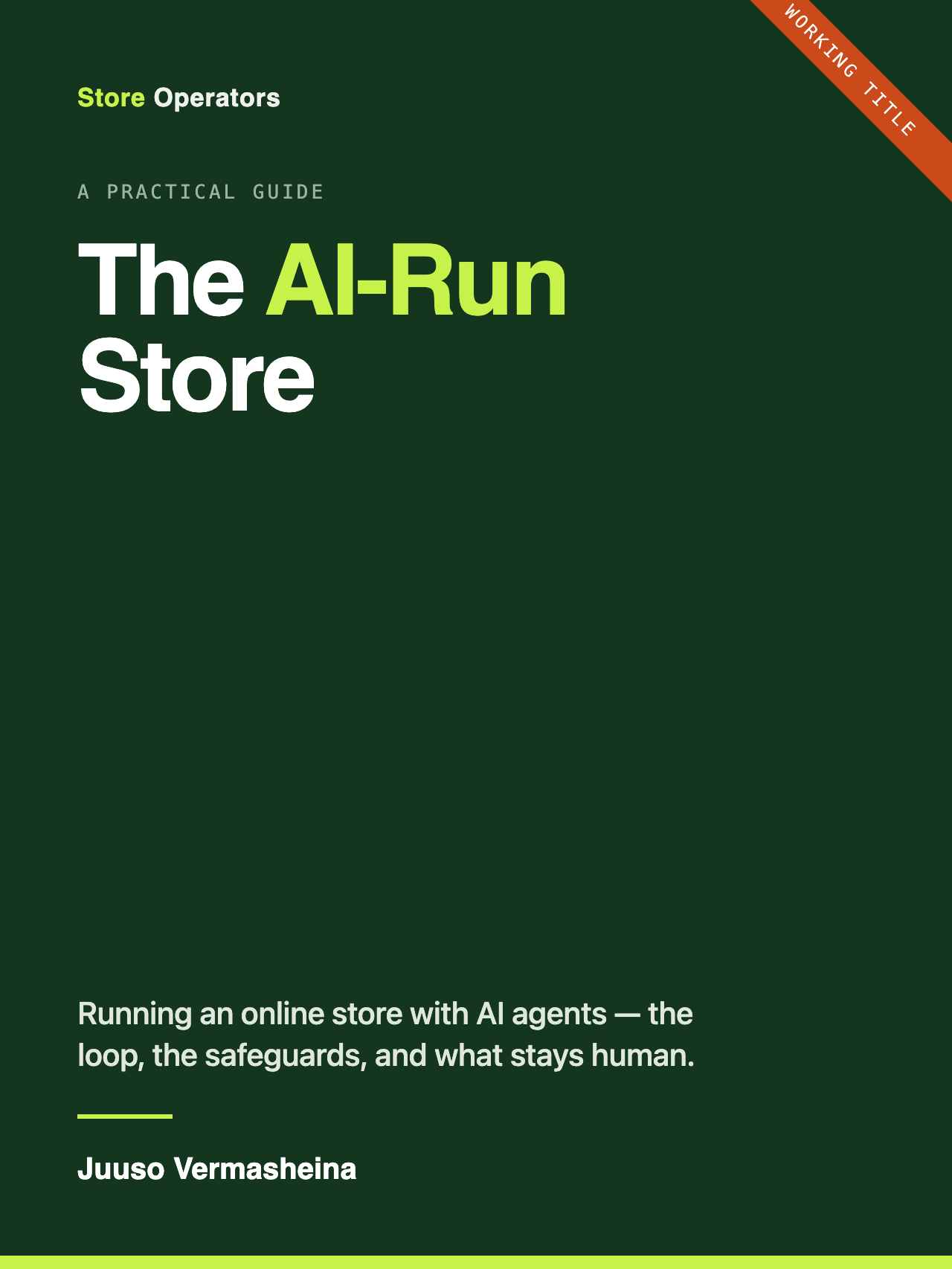
A practical book on letting an AI agent do your store's daily work without letting it break anything. 22 chapters: the loop, the safeguards, wiring, catalog, orders, marketing, being found by AI buyers, and what stays human.
The book is delivered to your email (EPUB + PDF), with the full toolkit included, a 29 € asset on its own. Email is required: it is where the download links land, and how we reach you later.
From doing to directing
A store's daily work — catalog, orders, support, campaigns — is the same every day. You used to do it. Now an agent can do it, if you can direct it: be clear about the outcome, check the work, and let it out into the world only when it's right. An agent is the first affordable “manager” a solo operator ever got.
“I didn't do the work. I directed the work. Then I checked it and let it out into the world. That shift — from doing the work to directing the work — is what this book is about.”
More shoppers ask an AI what to buy. Chapter 16 shows how a store gets found by the buyer's agent.
Shopify and WooCommerce hand agents more keys every year. Anyone can start today, few do it safely.
A well-run store in 2030 is more agent-native than today's. The rate is unknown, the direction isn't.
An operating system for your store
The book doesn't teach tricks. It teaches a layer underneath the store, the way your computer's operating system is the layer underneath everything: it decides what's allowed to run, keeps the records, and keeps the parts from colliding. Underneath is the system, on top are the modules.
The system
The layer underneath everything, the same for every store.
- ·the loop: explore → plan → confirm → execute → report
- ·custody: backup, confirm, verify, rollback
- ·the store's memory, the autonomy dial, the scheduler
The modules
The real jobs of a store, run on top of the system.
- +catalog, merchandising, inventory
- +orders, support, returns
- +marketing, analytics, being found by AI
Written out of one morning
I didn't write this from theory. I wrote it after I nearly wrecked a client's live store theme, because I had no method. Here is what happened, in my own words.
One morning I set an agent a small job on a client's live store: add one feature to the theme. A single function, a single change. I wrote the prompt carelessly, and I left the agent running on its own, taking its own steps while I half-watched. Then I saw it start writing to the theme, and saw it head the wrong way. Sitting there, it hit me that if I let it finish it would rewrite the core files of a live store's theme, and I had nothing to put them back. No backup. No snapshot. No rollback path. I hit escape. It stopped. Nothing had gone out, nothing broke, the store was fine. But the thing that saved that store was a reflex and a half-second of luck, not a method.
That morning is why this exists. The loop, the backup rules, the confirm gate and the rollback path are the safety layer I built afterward, so it could never again come down to luck and reflex.
What the book keeps from happening
An agent is fast, literal and tireless. It does exactly what you asked, at astonishing speed, including the parts you didn't mean. Without the method it isn't automation, it's a small, fast disaster with a receipt. These six are from the book, and each one is a custody failure, not a capability failure.
The agent rewrites a description. The admin shows the new one, not the old. The platform gave the ability to change the store, not to change it back. (ch. 3)
The source is silent on material, so the agent fills it plausibly. “Ceramic” — except the real answer is stoneware with a ceramic glaze, and that decides the dishwasher question. (ch. 7)
A bulk write isn't one transaction. A batch that fails halfway leaves half your products in the new state and half in the old, with no built-in way to unwind. (ch. 3)
A refund that runs without approval will, sooner or later, produce the wrong one. Money out, and you can't recall it from the customer's bank by asking nicely. (ch. 11)
An abandoned-cart email still references a discount retired last year. The silt is invisible until a customer replies that the code doesn't work. (ch. 12)
The agent starts rewriting a live theme's core files with no backup. Themes have no native version history on the platform — if you didn't snapshot, there is no way back. (ch. 1)
Every failure I've watched an agent produce in a live store has been a custody failure, not a capability failure. The tool worked. The safety architecture wasn't there. The book gives you that architecture.
The loop: five steps, one gate
The whole book runs on one loop. It's the discipline a competent person uses to run any project, but for an agent, which doesn't tire and doesn't hesitate. Confirm is the one non-negotiable gate: nothing reaches the store before it.
“An agent that runs before it looks isn't automation, it's a small, fast disaster with a receipt.”
§02 · Access vs. custody
Access is what the platform gives: a token, a plugin, a green checkmark. Custody is the four properties that make a write recoverable. Without all four you have access, not custody.
Access — what the platform gives
A button labeled “connect.”
- ·a token
- ·a plugin
- ·a green checkmark
Custody — what makes a write recoverable
Four properties, enforced.
- ✓a snapshot before the write
- ✓a moment to read the plan
- ✓a check after the write
- ✓a known path back
A snapshot of the fields about to change, taken just before the write, findable, and restored at least once. A backup you've never restored from is a hypothesis.
Confirm is the last human decision before the store changes. It's one decision on the whole plan, not a click through fragments.
An independent read of the store after the write, compared to the plan. Trusting the agent's own log is letting it grade its own homework.
You've walked it once, cold. A backup file isn't a rollback: the rollback is the process of getting from a bad state to a known good one.
“The gap is custody, not access. Every year the platforms hand your agents more keys, and better ones. Nobody's handing you the safe.”
22 chapters, four parts
Part I builds the system. Part II runs every store function on it. Part III covers building and being found. Part IV scales to a team and a portfolio.
“Total time from first sip of coffee to inbox-zero on the store's overnight work: forty minutes. Ten years ago, that was a whole day.”
For store operators
For merchants and operators who want to use AI agents to get work done, not just to experiment. No coding background needed. If you can manage — be clear about the outcome, honest about the constraints, willing to check — you already have the hard part.
“I did the exact thing this book tells you not to do. That's why this book exists. Now you have it before you need it. That's the only real difference between us.”
The book and the toolkit in one
The book is delivered to your email (EPUB + PDF), with the full toolkit included, a 29 € asset on its own. Email is required: it is where the download links land, and how we reach you later.
The toolkit alone is 29 €. With the book it costs nothing; you open it with the code on the back of the book. So 49 € is the book and a 29 € tool together.
The book is by Juuso Vermasheinä, founder of Store Operators. I've run my own and client stores with AI agents since 2025, and built a guardrail system after my own near-miss. The same method sits behind this site's tools and the hosted Store Operators app. The book is what I've learned by doing it, not from theory.
Common questions
EPUB and PDF. EPUB for e-readers and apps, PDF for printing and reading on screen. Both in one purchase. There is no audiobook yet.
The layer underneath everything: the loop, custody, the store's memory, the autonomy dial and the scheduler. On top of it run the modules, the real jobs of a store. The book teaches the system first, then the modules one at a time.
The prompts and checklists you build the book's loop into your own store with. It sells on its own for 29 €, but with the book it's free, through the code on the back of the book.
No. If you've ever managed a person, been clear about the outcome, honest about the constraints, willing to check the work, you already have the hard part. Every technical part is explained in plain words.
The book teaches the shape, not one model or tool. The loop and the four rules are a discipline, not a technology, and they apply to the next generation of agent too.
You can start on Monday on Shopify, WooCommerce or whatever you run, with Claude, ChatGPT or Gemini. Every chapter is operable with the tools you have today.
Right after payment. The download link and the toolkit access link land in your email.
Book + toolkit, €49
One payment. You get 22 chapters instantly in EPUB and PDF, with the toolkit included. You can start Monday on the platform and agent you already have.
The book is delivered to your email (EPUB + PDF), with the full toolkit included, a 29 € asset on its own. Email is required: it is where the download links land, and how we reach you later.
Start with the free course
A short, visual course shows the same method on a real store. Free, and it tells you whether to go deeper.