Add product JSON-LD to Shopware 6 (for developers and for your AI agent)
The exact, verified way to put AI-search JSON-LD on a Shopware 6 product page — server-side, and multilingual. Do it yourself with the steps below, hand the runbook to your AI agent, or let Store Operators do it for you.
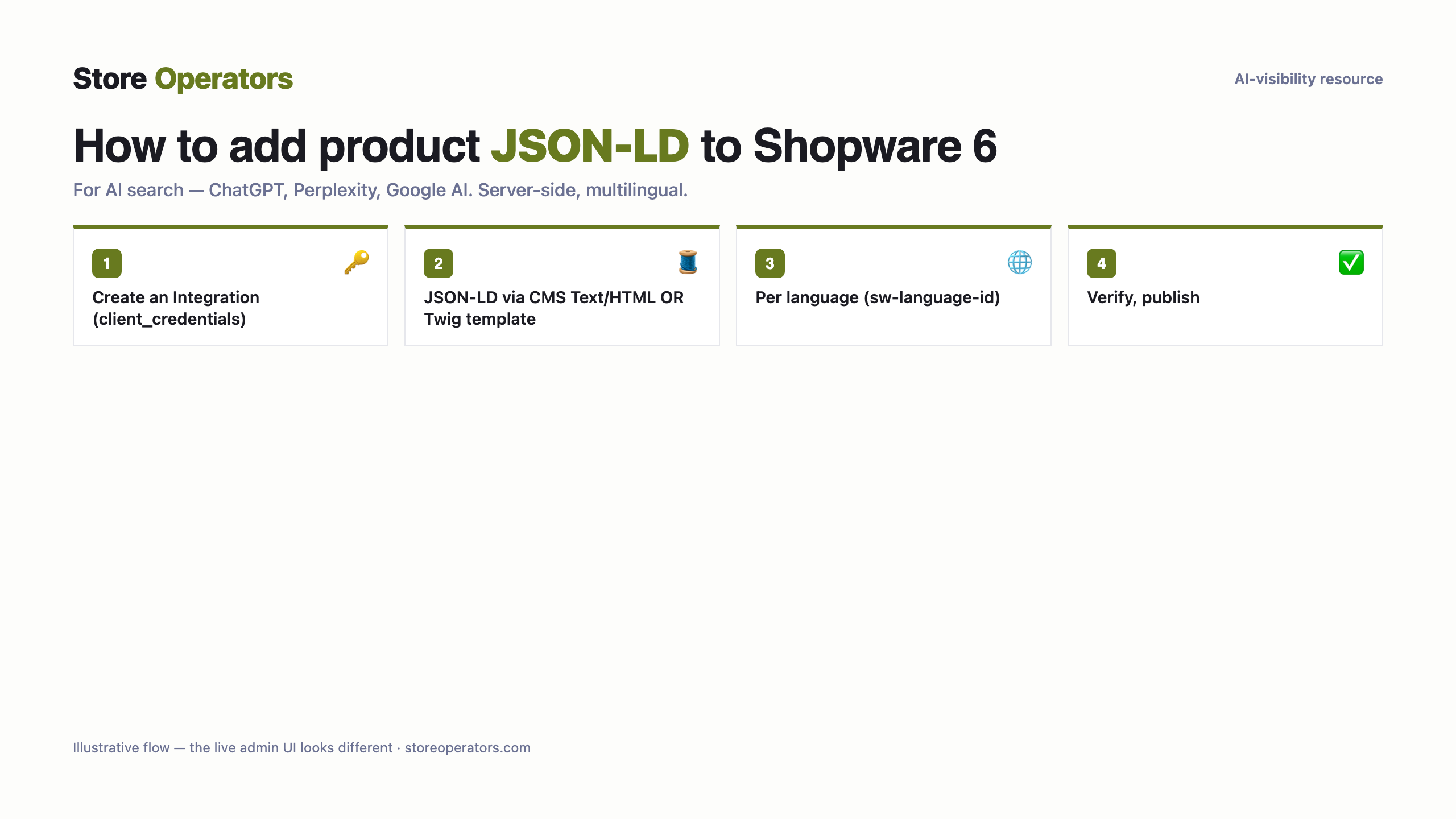
The Shopware 6 JSON-LD flow at a glance (illustrative diagram).
For a developer
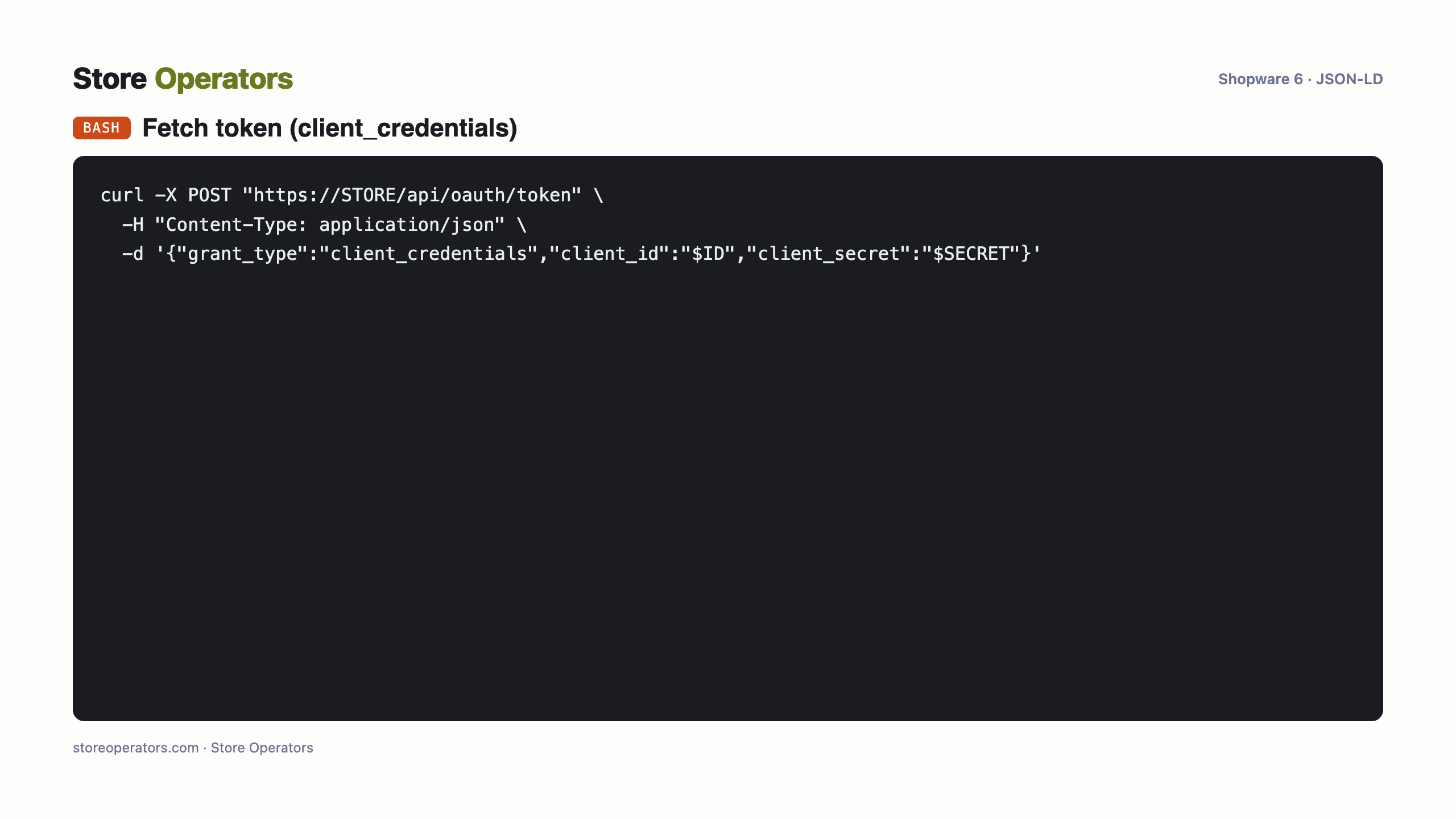
Create an Integration (Settings → System → Integrations) → OAuth client_credentials token (~10 min TTL).
Inject the JSON-LD via a CMS 'Shopping Experiences' element assigned to the product — the raw-HTML block is a Rise+ feature (and needs HTML-sanitizer config or tags get stripped); on open-source use the Text element (renders HTML). Or edit the Storefront Twig template via file access, then `bin/console cache:clear` (note: `theme:compile` is only for SCSS/JS assets, not Twig).
Per language: use the Language entity / sw-language-id header and emit that language's JSON-LD.
Per language via the Language entity / sw-language-id; emit that language's JSON-LD.
View source per language URL: application/ld+json present.
The exact code
Prompt for your AI agent — connect Shopware 6 & implement
A complete copy-paste prompt for your own AI agent (Claude / ChatGPT). It tells the agent how to connect to your Shopware 6 store and implement the JSON-LD for you — with safe-write discipline: backup, preview, verify, and your approval before publishing.
You are helping me add AI-search JSON-LD to ONE product on my Shopware 6 store, safely.

SAFETY (follow exactly, in order):
  1. Back up first: duplicate the current theme (or export it) BEFORE any write. No exceptions.
  2. Work on an UNPUBLISHED copy / preview — never edit the live theme directly.
  3. Use a least-privilege token: only the scopes the task needs.
  4. After each change, VERIFY (fetch the page, confirm the JSON-LD renders and is valid).
  5. Do NOT publish. Show the human the preview and the verification, and let the human approve the publish.
  6. Keep the rollback ready: if anything looks wrong, restore the backed-up theme.

CONTEXT: Product URL: https://your-store.example/product/your-product. Store locales: your primary language.

ACCESS:
  A Shopware 6 Integration (client_credentials); or filesystem access for Twig + bin/console.

TASK:
  1. Create an Integration and fetch a client_credentials token (short TTL — refresh).
  2. Add the JSON-LD via a CMS Text/HTML element on the product (or the Storefront Twig template via file access + theme:compile).
  3. Emit per language (sw-language-id), verify the source, then have the human publish.

JSON-LD to inject:
{}
Questions people ask their AI
What is the prompt to connect Claude to Shopware 6 to add product JSON-LD?
Use the runbook on this page — paste it into Claude. It connects to your Shopware 6 store with your own credentials and adds the schema.org JSON-LD, with backup, preview, verification and your approval before publishing.
How do I connect ChatGPT to my Shopware 6 store to add schema.org JSON-LD?
The same runbook works for ChatGPT (or any capable AI agent): it authenticates to your store and injects the JSON-LD server-side, safely, and stops for your approval before publishing.
Can an AI agent add product JSON-LD to Shopware 6 for AI search (ChatGPT, Perplexity, Google AI)?
Yes — server-side (client-side-only JavaScript is not reliably seen by AI crawlers). Do it with the agent runbook here, hand it to a developer, or have Store Operators do it for you.