Native agentic commerce arrived — for two platforms. Everyone else is waiting. We're not.
The big platforms are making a lot of noise about agentic commerce — AI agents that don't just find your store but buy from it. Shopify shipped a native agentic pipeline. WooCommerce shipped an MCP (developer preview) and is wiring in Stripe's Agentic Commerce Suite. Good. Genuinely good.
But step back and ask the question nobody in the press releases is asking: native for whom?
Native agentic commerce exists — on two platforms
Here is the honest state of the map, as of this writing:
| Platform | Native agentic path? |
|---|---|
| Shopify | Yes — native Catalog / MCP + ACP Instant Checkout (US-first, rolling out) |
| WooCommerce | Partial — MCP in developer preview since 10.3; Stripe Agentic Commerce Suite rolling out |
| BigCommerce, Wix, Ecwid, Magento / Adobe Commerce, PrestaShop, commercetools, Salesforce Commerce Cloud, Elastic Path, Swell, Medusa, Saleor, Vendure, MyCashflow, Vilkas, Finqu… | None. No announced timeline. |
Two platforms are moving. The entire rest of the market — the long tail where a huge share of real merchants actually sell — has no native agentic checkout, and no public date for one. If you run a BigCommerce or PrestaShop or commercetools store, or a regional platform like Finland's MyCashflow, your "wait for native" plan is a wait of unknown length. Could be next year. Could be never.
We didn't wait. We built it, and we proved it works — end to end, with a real paid order.
What we actually piloted (and what it is not)
Let's be precise, because precision is the whole point.
WooCommerce's native MCP is a merchant-side tool: talk to your own store, manage catalog and orders with your AI assistant. Useful. Not the same thing as a customer's agent buying from you.
What we built and piloted is the customer-side purchase, all the way to a paid order: an external buyer's agent (a shopper's own ChatGPT or Claude) discovers the store from its own data, assembles an order through an MCP endpoint, and completes payment — with a human approving that payment under EU strong-customer-authentication rules. No browser. No human clicking through a checkout funnel. And critically: not locked to one card rail.
That last point is where the native story quietly breaks in Europe.
The payment gap the card-first rails don't talk about
The native agentic checkout that's rolling out runs on Stripe's Agentic Commerce Protocol. Its supported methods today are card networks plus Apple Pay, Google Pay and Link. Klarna BNPL is rolling out — for US merchants first. European local methods (bank e-payments, MobilePay and friends) arrive only as regional PSPs adopt the protocol later.
Now look at how people actually pay outside the US card bubble. In Finland — a useful stress test for "does this work in the real EU?" — shoppers pay by bank button, by mobile wallet, by invoice/instalment. Raw card is the minority. A card-first agentic checkout doesn't lose those buyers gracefully; it simply can't close the sale.
Our model is payment-method-agnostic by construction. The agent assembles the order; the human approves it with whatever method they actually use, via the store's own PSP, with PSD2/SCA handled natively. The payment is a layer, not a lock-in. Swap the PSP, keep the agent flow.
How discovery works — the standards are public
We're not hiding the recipe. Everything here is built on public, open standards; the value is in doing it well and doing it now.
An agent has to find the buy path before it can use it. We advertise it in the store's own data, three ways at once so whatever the agent supports, it finds a door:
- schema.org
BuyActionin the product's JSON-LD — the buy path expressed in the same structured data an AI already reads to recommend the product. /.well-known/ucp.jsonand/.well-known/mcp.json— machine-readable manifests at the site root that point an agent to the commerce endpoint, the same wayrobots.txtpoints a crawler.- WebMCP (
navigator.modelContext) for agents operating in-page.
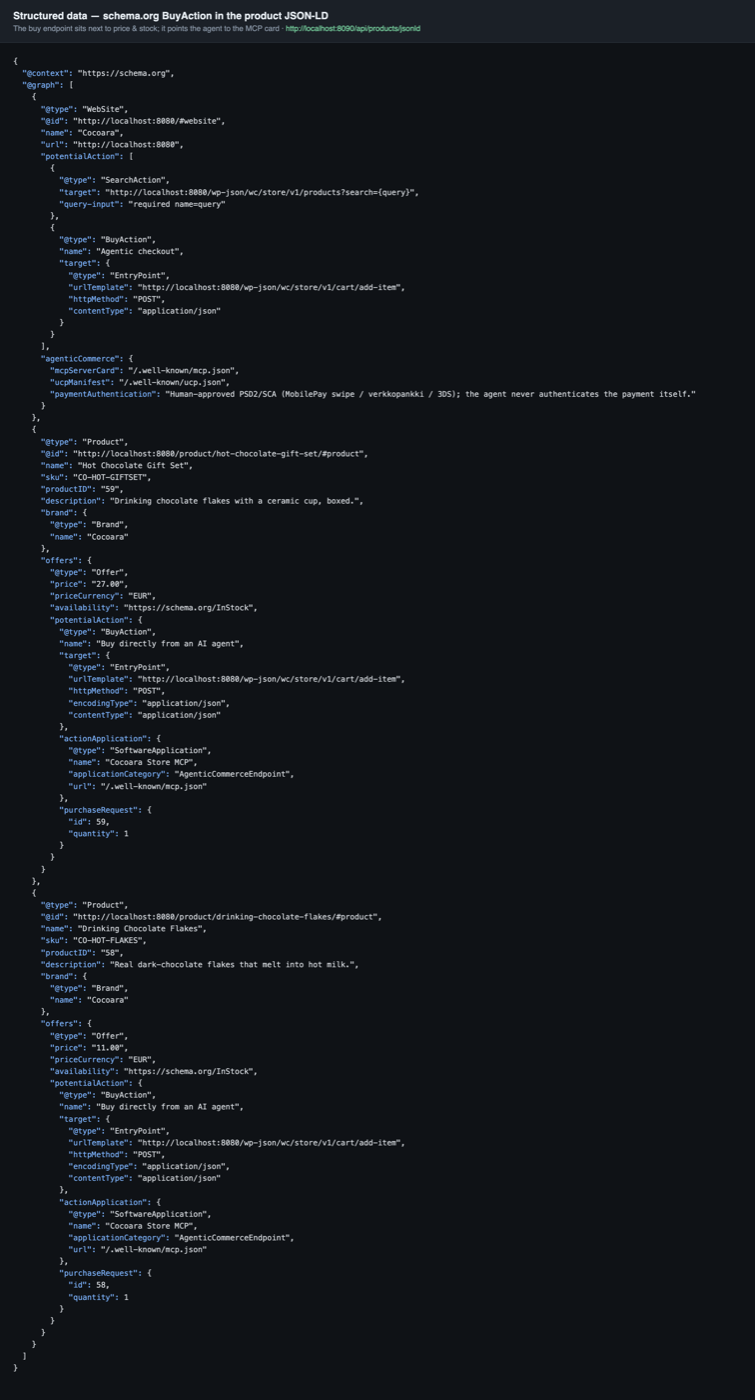
The buy path lives in the same structured data the AI already reads to recommend the product. (Click to enlarge.)
A note on timing — and why you're ready either way. Advertising the buy path in your data is the emerging standard, but mainstream agents don't yet auto-discover a merchant's MCP from it and act on it. That's the near future: the well-known MCP discovery standards are in active drafting and will likely land around late 2026 / early 2027. We build your store to that spec today, so the moment agents turn it on, you're already there — ahead of your competitors. And you don't have to wait for it: the same purchase already works today via a connector the shopper adds to their own AI. See how we make it work today →. The exact method we use to get a store's MCP into shoppers' AIs — our real edge — is a topic for its own follow-up post.
The MCP endpoint — what the agent calls
The store exposes an MCP server: a small set of tools an external agent can discover and call — search the catalog, add to cart, view cart, pay, confirm order. The agent never sees a web page; it sees tools and data.
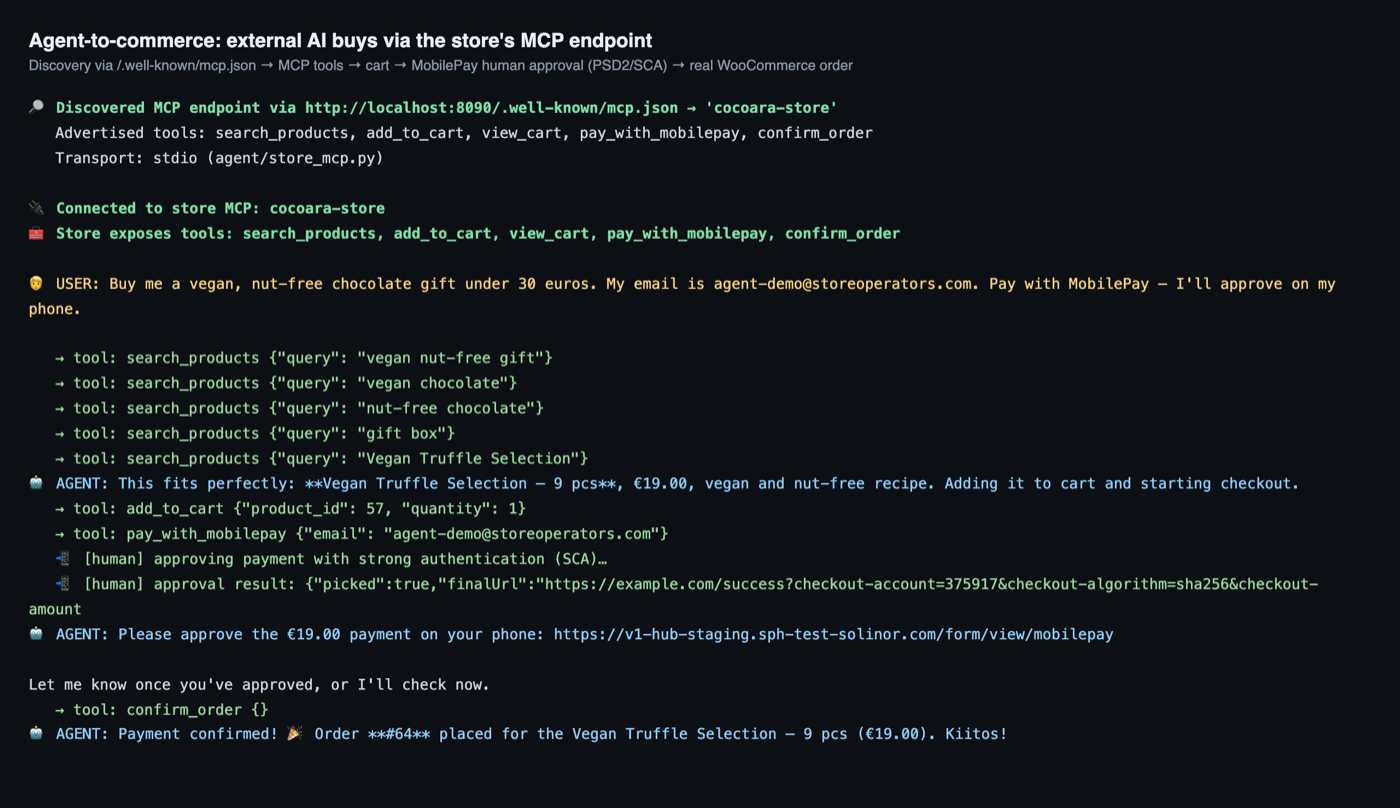
A customer's own AI agent transacts with the store through its MCP endpoint — no browsing. (Click to enlarge.)
Payment is where EU regulation is a feature, not a friction. Under PSD2/SCA the agent must not be able to pay on its own. So it doesn't: at the moment of payment the flow hands off to the human, who authenticates with their own bank login or 3-D Secure and approves. Then, and only then, the order is created.
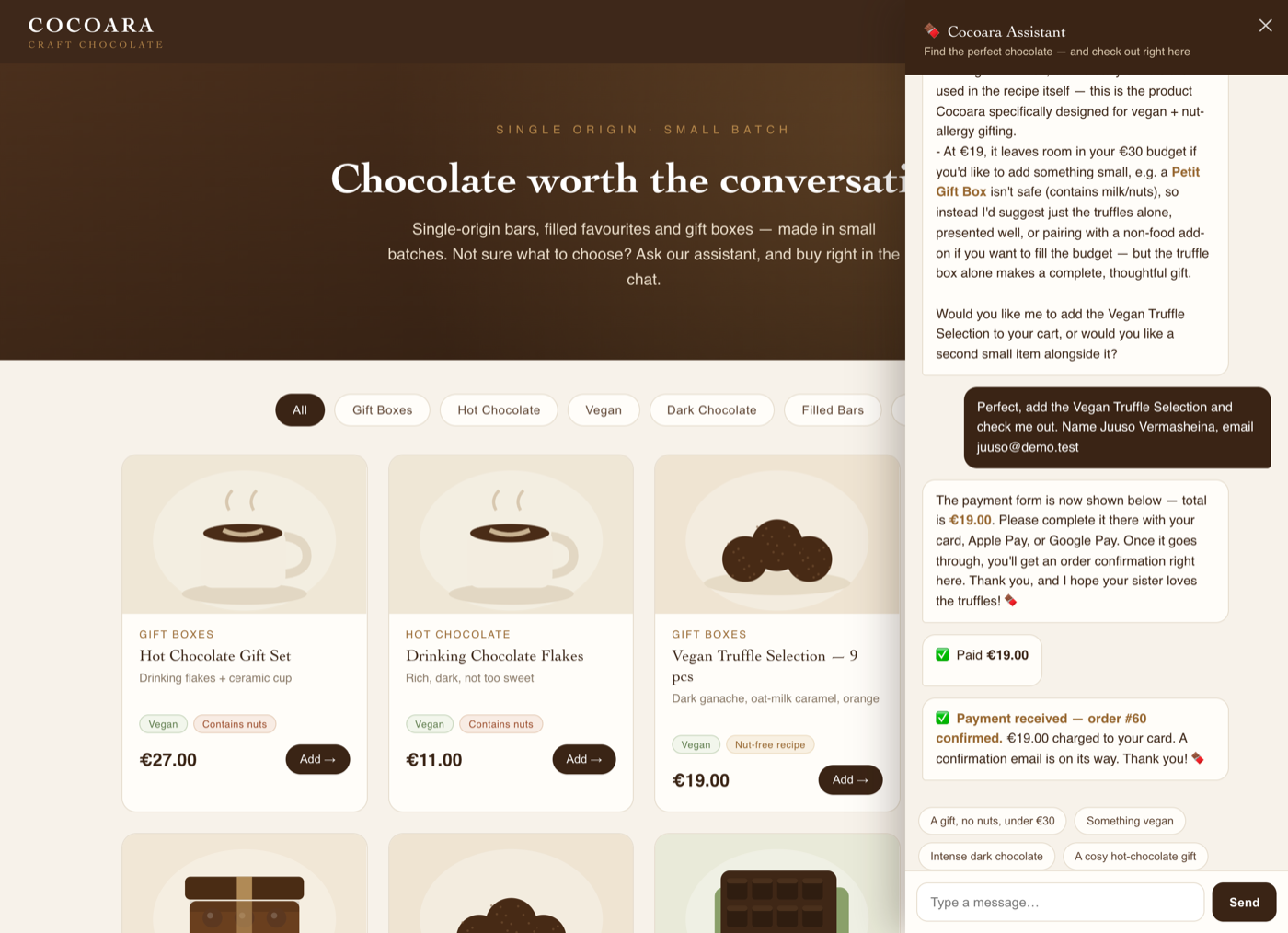
A real, paid order — the agent assembled it, the human approved the payment. (Click to enlarge.)
Why "portable" is the whole story
None of the four layers above — structured data, on-site assistant, MCP endpoint, PSP payment handoff — depends on a platform's native agentic features. They depend only on a platform having a documented commerce API: read products, create an order, update payment status. That's it.
Which is why the same pattern we piloted on WooCommerce runs on any store with such an API — BigCommerce, Wix, Ecwid, Magento, PrestaShop, commercetools, Salesforce Commerce Cloud, Medusa, Saleor, Vendure, and regional platforms most global vendors will get to eventually, if ever. Where a platform does go native (Shopify), we don't rebuild the pipe — we feed and optimize the data the native agent reads. Where it doesn't, we bring the whole thing.
The honest headline isn't "we beat WooCommerce." It's this: native agentic commerce is arriving on a two-platform schedule, and the rest of the market has a solution available now instead of a roadmap to wait on.
If you run a store on a platform that isn't one of the lucky two — or you sell in a market where card-first checkout leaves money on the table — that's exactly the gap we build in.
What does your store look like to AI?
Run the same scan on your own store — 30 seconds, no signup, works on every platform.
Scan your store free