The layers of agentic commerce: what shrinks, what endures
Agentic commerce is being framed as a race: OpenAI and Stripe's ACP against Google and Shopify's UCP. Which one wins? That is the wrong question. It makes a merchant wait for a winner and build for it, when the right move is to see what sits underneath all of them, and which part endures no matter which name survives.
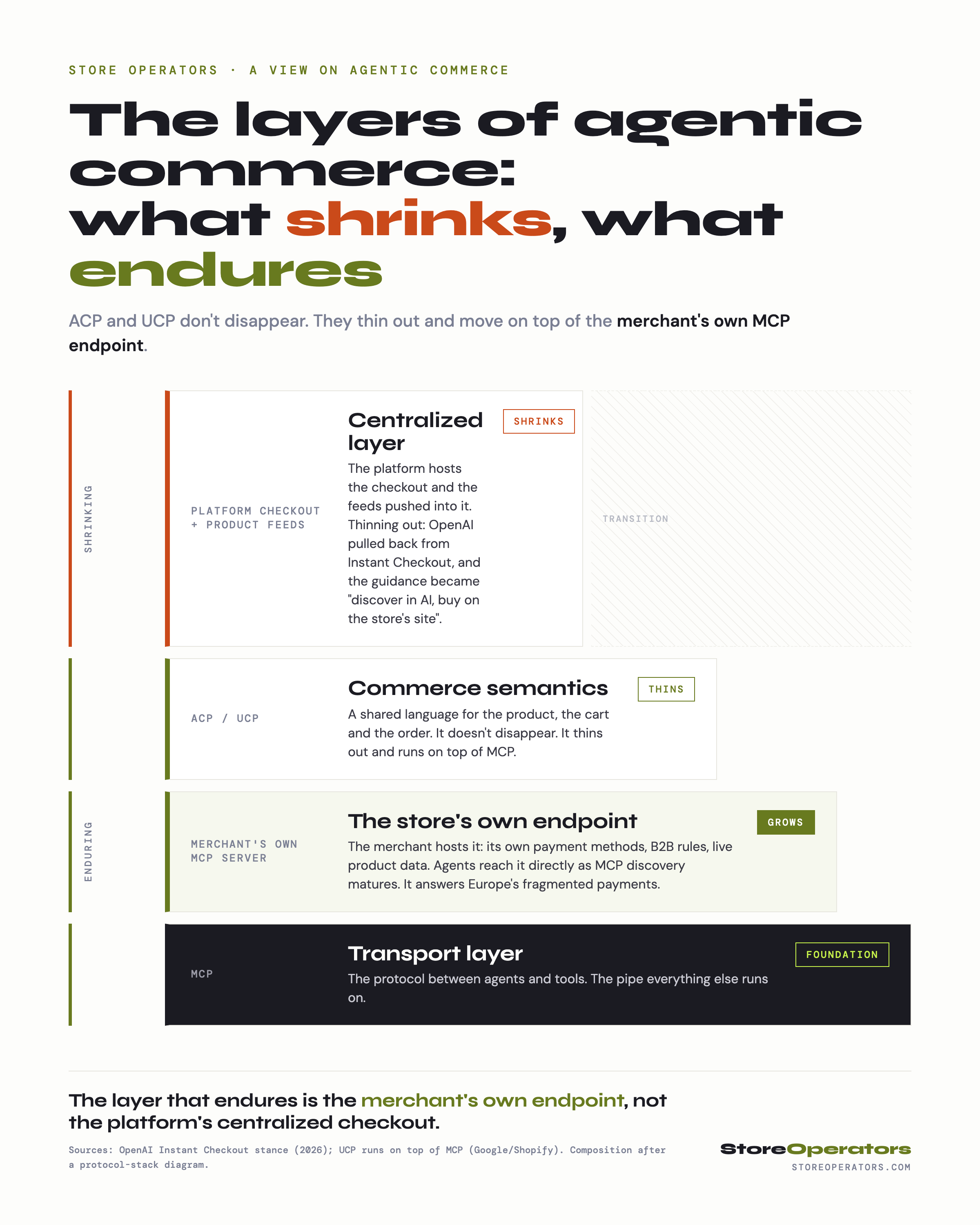
Here is how we read it, in one image. The picture widens as it goes down: the centralized layer closest to the agent is narrow and shrinking, the foundation is wide and endures.
The base is a pipe, not a store
MCP (Model Context Protocol, Anthropic) is the transport layer. It is how an agent talks to a tool: fetch a product, quote shipping, place an order. It knows nothing about commerce itself. It is the pipe everything else runs on. This layer is not contested, and that is exactly why it is the part to lean on.
ACP and UCP sit one layer up. They are commerce semantics: a shared language for the product, the cart, the order, and the payment. ACP came out of OpenAI and Stripe (29 Sep 2025), UCP out of Google and Shopify (11 Jan 2026). Both solve the same problem in slightly different words, and both run in practice on top of MCP-style transport. So they are not an alternative to the pipe. They are the content that moves through it.
The centralized layer thins out
The top layer gets the most attention and still shrinks: the platform's own hosted checkout and the product feeds pushed into it. The idea was that you buy inside the AI, and the platform handles the payment.
The direction already turned once. OpenAI pulled back from the aggressive form of Instant Checkout, and the message moved closer to "discover in AI, buy on the store's site" (CNBC, 20 Mar 2026). That is one data point, not a law, but it tells you something. When a platform takes the checkout, it also takes on payments, refunds, regulation, and the hundred country-specific payment methods it does not know. That is heavy, and it does not scale into Europe's fragmented payments.
Feeds share the same fate. Pushing a product feed to a platform is a copy that goes stale the moment you send it. Price changes, stock changes, the return policy changes, and the feed falls behind. The durable way is to let the agent read live data straight from the store at the moment it asks.
The part that endures is the merchant's own endpoint
The lower you go in the picture, the wider and more permanent the layer gets. The foundation is the merchant's own hosted MCP endpoint: the store's own server that answers the agent directly.
That is where the things the centralized layer can't handle live. The store's own payment methods, European ones included. B2B rules: contract pricing, buying authority, payment terms. Live product data that never goes stale, because it is read at the moment of the request. As MCP discovery matures (part of it is still at the proposal stage, not finished), agents reach this endpoint directly. At that point the store no longer depends on whether some platform accepted its feed.
ACP and UCP do not disappear in this world. They thin out and move on top of the merchant's own endpoint as a thin semantic layer. The layer that endures is the merchant's own endpoint, not the platform's centralized checkout.
What this means for a merchant
Don't bet on one platform's checkout and wait to see which protocol wins. Build the two things that survive either outcome.
First, structured, live product data an agent can read directly. Then your own endpoint that speaks to the agent with the store's own payment methods and rules. These work with ACP, with UCP, and after them, because they sit on top of the pipe rather than inside one platform's checkout.
How we are preparing for this now
We are building exactly this layer. The Store Operators WooCommerce plugin publishes the store's own MCP endpoint and its /.well-known address, so an agent can find it. The store's own checkout takes the payment with the store's own methods, and in Europe a human confirms every payment (PSD2/SCA). We have run this end to end on a real WooCommerce store with a European payment method. Product data is read live, not from a copied feed, so an agent is never handed a stale price or return policy.
In other words, we are not waiting to see which protocol wins. We are building the layer that survives either one.
If you want to see where your store stands now, run the free AI visibility test or book a review: storeoperators.com.
Sources
- MCP: Anthropic, Model Context Protocol (modelcontextprotocol.io)
- ACP: OpenAI + Stripe, Agentic Commerce Protocol (29 Sep 2025)
- UCP: Google + Shopify (11 Jan 2026); AP2: Google, Agent Payments Protocol (16 Sep 2025)
- OpenAI Instant Checkout shift: CNBC 20 Mar 2026
- EU payments and agentic commerce: Nexi + Google Cloud (3 Mar 2026); Paytrail, agentic commerce; Taylor Wessing (Feb 2026)
- MCP discovery (
.well-known, MCP Registry): at the proposal stage in 2026, not yet settled
What does your store look like to AI?
Run the same scan on your own store — 30 seconds, no signup, works on every platform.
Scan your store free