Agentic B2B commerce: the merchant's playbook for when AI does the buying
Soon the buyer's AI will do the buying. It finds a supplier, compares, reorders, handles the contract price and the PO number. This is not a forecast. It is a shift already underway, and it breaks the two things a B2B store has leaned on: advertising and search ranking. This is the playbook for what replaces them. Every section is sourced, forecasts are marked as forecasts, and there is not one invented number in it.
The short version
A B2B store can't buy its way in front of the buyer's AI, because a buyer on a company account sits in an ad-free tier. It can't rank its way in either, because the AI answers the question in place and the user never clicks a result. That leaves one channel: being the supplier the buyer's AI finds and picks on its own. That is a data and structure problem, not a media-buying one. And B2B has one extra layer that consumer protocols ignore: contract pricing, entitlements, payment terms, and buying authority. That layer is the merchant's advantage, if you build it.
How big a shift is this
The direction is unanimous, even though the numbers are forecasts and vary by source.
Gartner predicts that by 2028, 90% of B2B buying will be mediated by AI agents, with over 15 trillion dollars of B2B spend moving through them (Gartner Top Strategic Predictions 2026, published 21 Oct 2025). That is a forecast, not a measured fact, but it shows where analysts are looking. McKinsey estimates agent-mediated commerce reaching 3 to 5 trillion dollars globally by 2030, weighted toward consumer retail (DigitalCommerce360, 20 Oct 2025).
The measured data says the shift has already started. Adobe measured AI-referred traffic to online stores up 693% year over year in the 2025 holiday season, and up 393% in Q1 2026 (Adobe, January 2026). Salesforce measured AI and agents influencing 20% of Cyber Week 2025 purchases (Salesforce, 5 Dec 2025). The absolute level is still small, but it is the fastest-growing channel there is.
The takeaway: B2B ecommerce is several times larger than B2C and still compounding double digits, so the prize behind agent discoverability is disproportionately large in B2B.
Why ads don't solve B2B
OpenAI began showing ads in ChatGPT on 9 Feb 2026, but only on the Free and Go tiers. Plus, Pro, Business, Enterprise, and Education are ad-free (TechCrunch, 9 Feb 2026; OpenAI, Ads in ChatGPT). This one structural fact should stop any B2B brand that is thinking about ChatGPT ads.
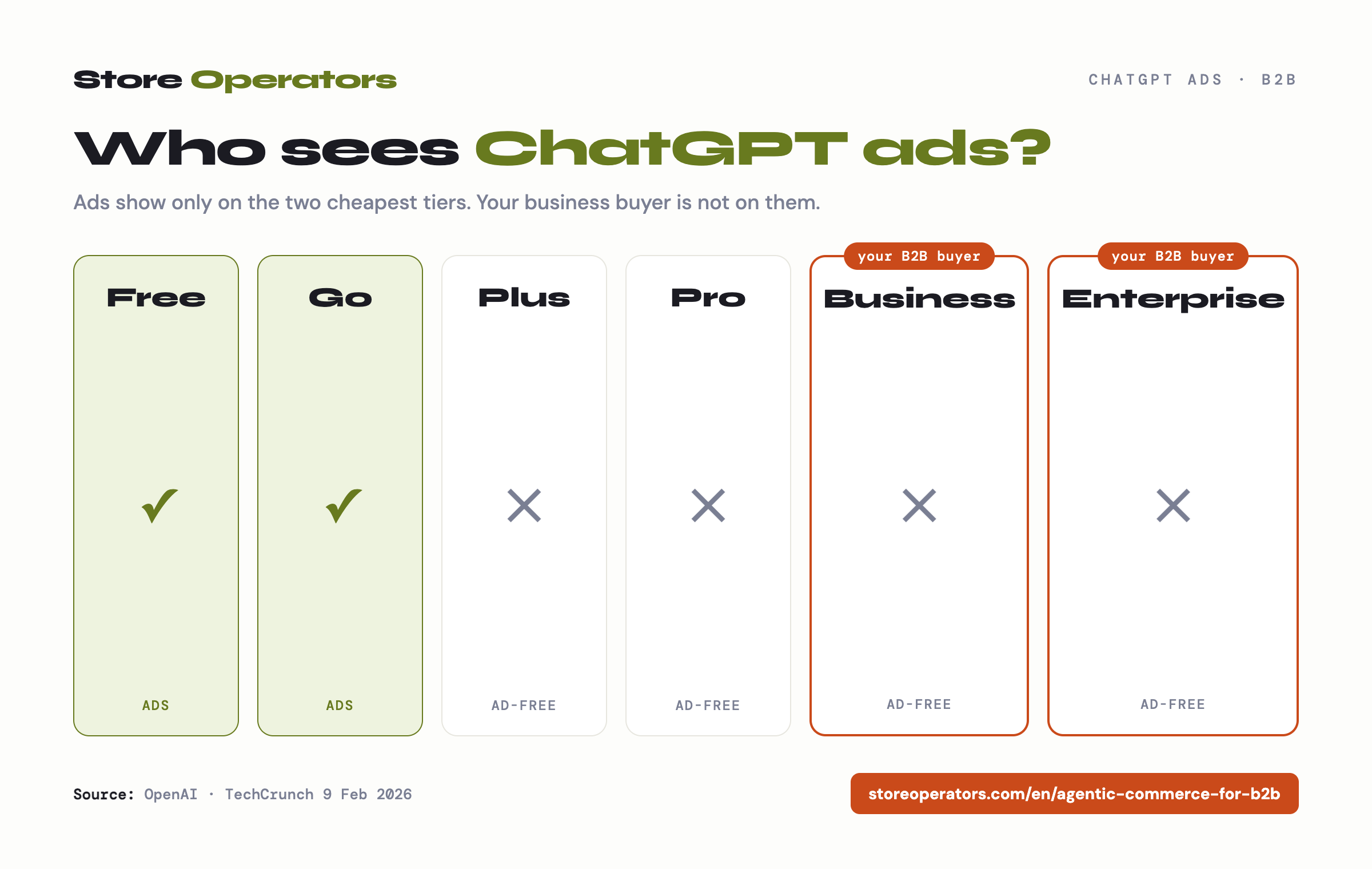
A business buyer does serious research on a work machine, on a Business or Enterprise account. There is not a single ad there. When you pay for a ChatGPT ad with a B2B campaign, you buy the exact audience that sits on Free and Go: students, curious people, and bots. Not the person who signs off on the purchase.
I read a test where a company ran ChatGPT ads for a Swiss B2B client, a little over a thousand francs. The top of the funnel looked fine: 48,000 impressions, a 0.72% click rate, better than most get on LinkedIn. But little arrived. The platform reported 350 clicks, analytics saw 131 sessions, and two thirds of the clicks never showed up as a session at all. The easy read is measurement. The real read is the audience. The ad ran on the wrong tier, and the wrong tier does not convert on a B2B offer with any pixel.
A fair caveat: ChatGPT ads can still work for B2C-adjacent, top-of-funnel, or small-business targets who sit on Free and Go. The limit is about the enterprise buyer, not all advertising.
The takeaway: if you sell to businesses, you can't buy your way in front of the buyer in ChatGPT. You have to be the answer the model surfaces on its own.
And you can't rank your way in like before
The old funnel was rank, click, site. It is breaking. About 68% of US Google searches ended with no click in 2026 (estimates vary; Similarweb measured 58.5% US for 2025). Pew Research measured (July 2025) that with an AI Overview present, only 8% of users click an organic result, versus 15% without. Semrush found about 93% of AI Mode searches end with no click out (updated September 2025).
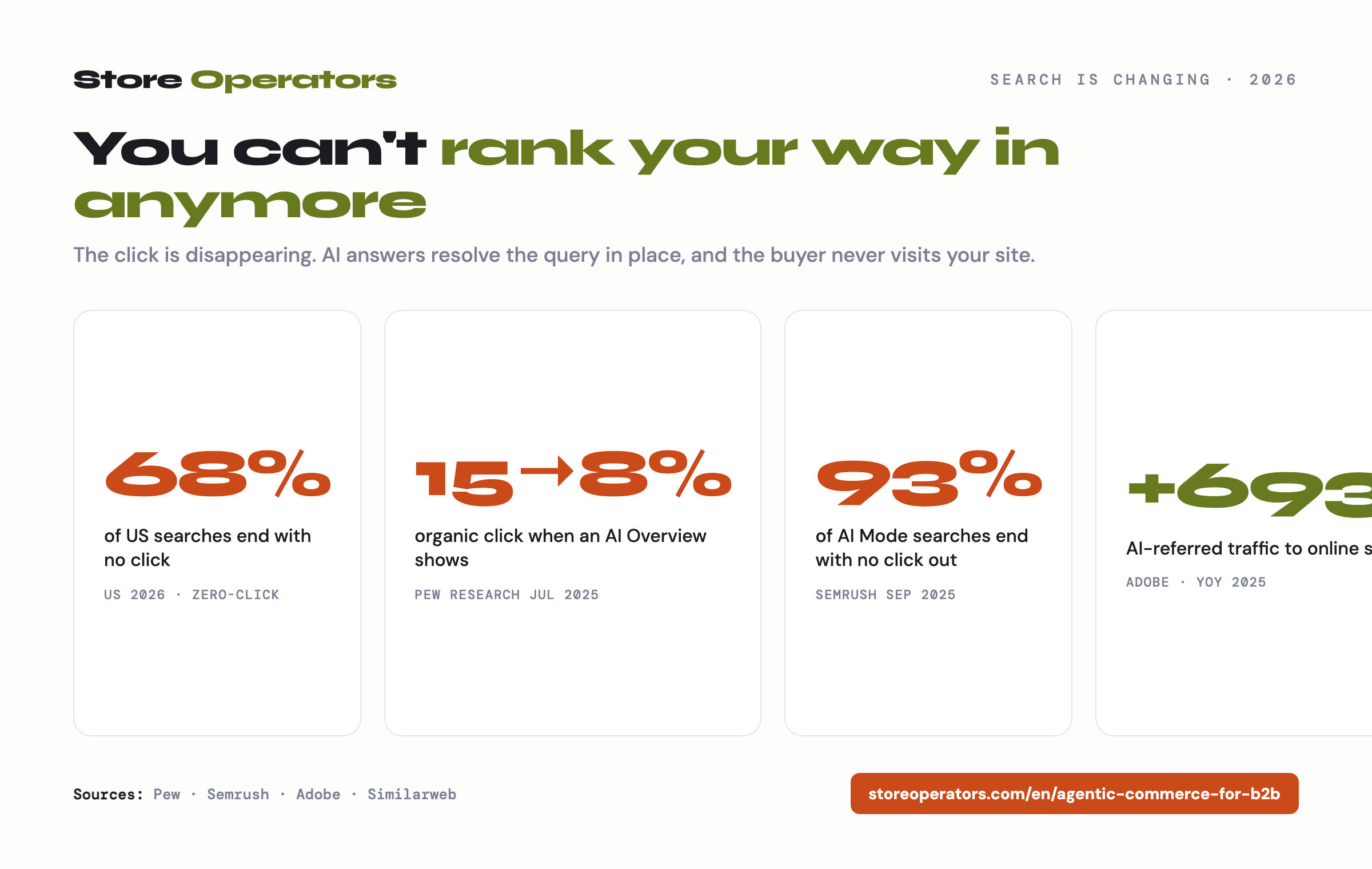
At the same time, pages that get cited inside the AI answer see more traffic and convert better. Being in the answer replaces the ranking. That is the visibility a B2B store now has to build.
How the buyer's AI actually finds and picks a supplier
This is where many people sell the wrong medicine, so let's stay with what the platforms' own docs say.
There are several bots, and they do different jobs. OpenAI runs at least four (GPTBot for training, OAI-SearchBot for the search index, ChatGPT-User for live fetch, OAI-AdsBot), and it states that if you block OAI-SearchBot, your site will not show in ChatGPT search answers. Anthropic runs three bots that all honor robots.txt, and blocking Claude-SearchBot can reduce visibility. Google-Extended does not control appearance in AI Overviews, because those run on the normal search index. So you decide per function: let the search and answer bots in, choose separately on the training bots.
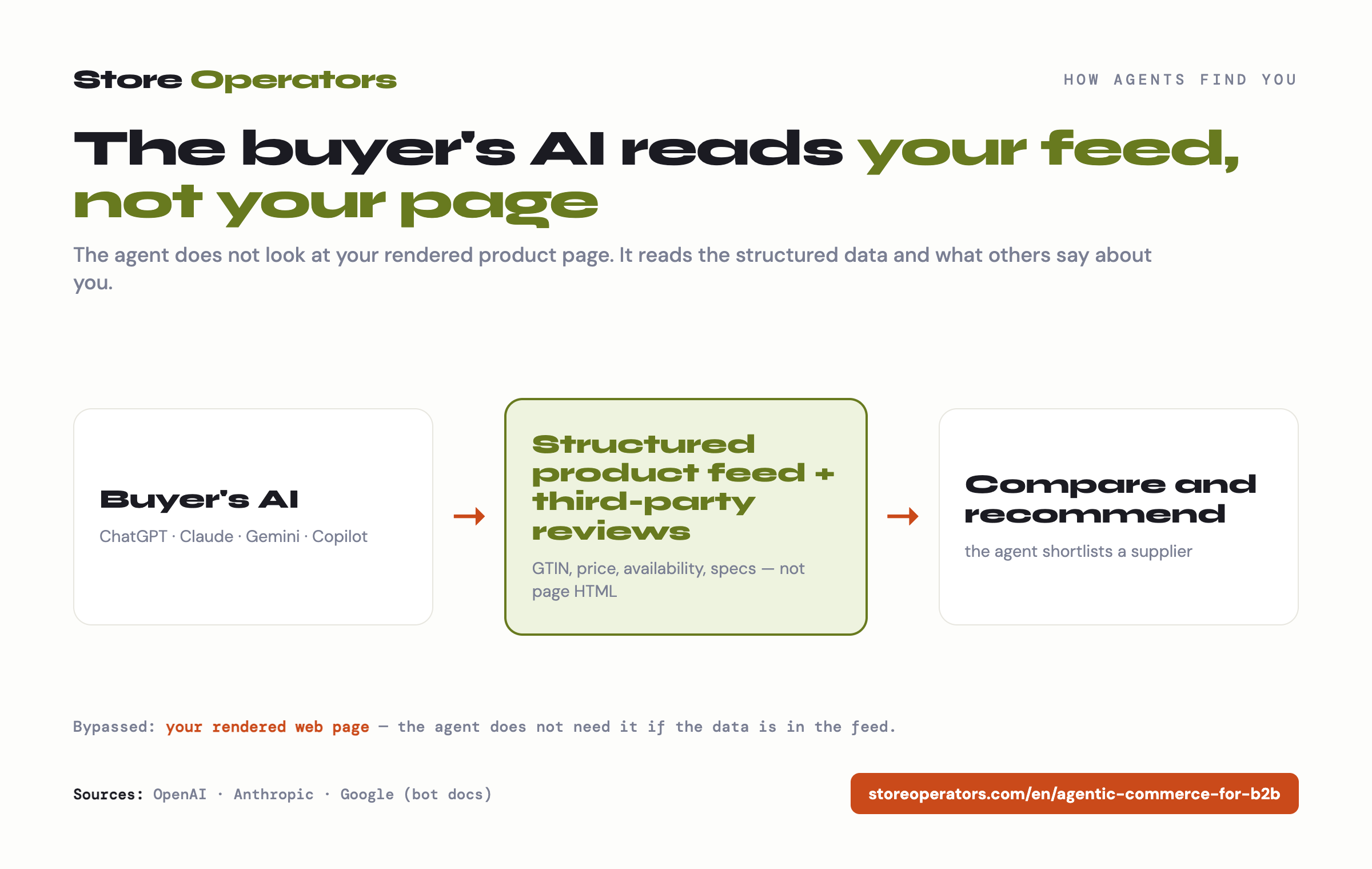
In shopping, the data comes from the feed, not the page. This is the key point. Google states plainly that AI Overviews and AI Mode need no special schema.org structured data, only that the page is normally indexed. Shopping answers, though, rest on separate feeds: Google's shopping answers on the Merchant Center Shopping Graph, ChatGPT's on the merchant feed plus the OAI-SearchBot crawl, Perplexity on the merchant's own feed. On-page JSON-LD is a parsing aid, but product data travels through the feed.
Third-party reviews carry a lot of weight. An independent study (Cloro, 3,312 prompts, six engines, May to September 2026) found that AI product recommendations cite YouTube, Reddit, and review sites the most, and that a brand's own pages get cited far less. There is no rank one for a product. That means your earned review and media coverage is part of discoverability, not just your page.
The takeaway: make bot decisions per function, treat the product feed as the primary route into AI shopping answers, and earn third-party coverage, because that is what gets cited.
What is genuinely different in B2B
Here is the part consumer protocols skip, and that is exactly why it is the merchant's advantage.
A B2B price is account-specific from the start. Each customer sees a negotiated price, and a distributor usually runs several pricing structures: fixed contract prices per SKU, volume tiers, customer-class discounts, regional prices. On top of that come PO numbers, payment terms, minimum order quantities, VAT handling, and multi-step approval chains.
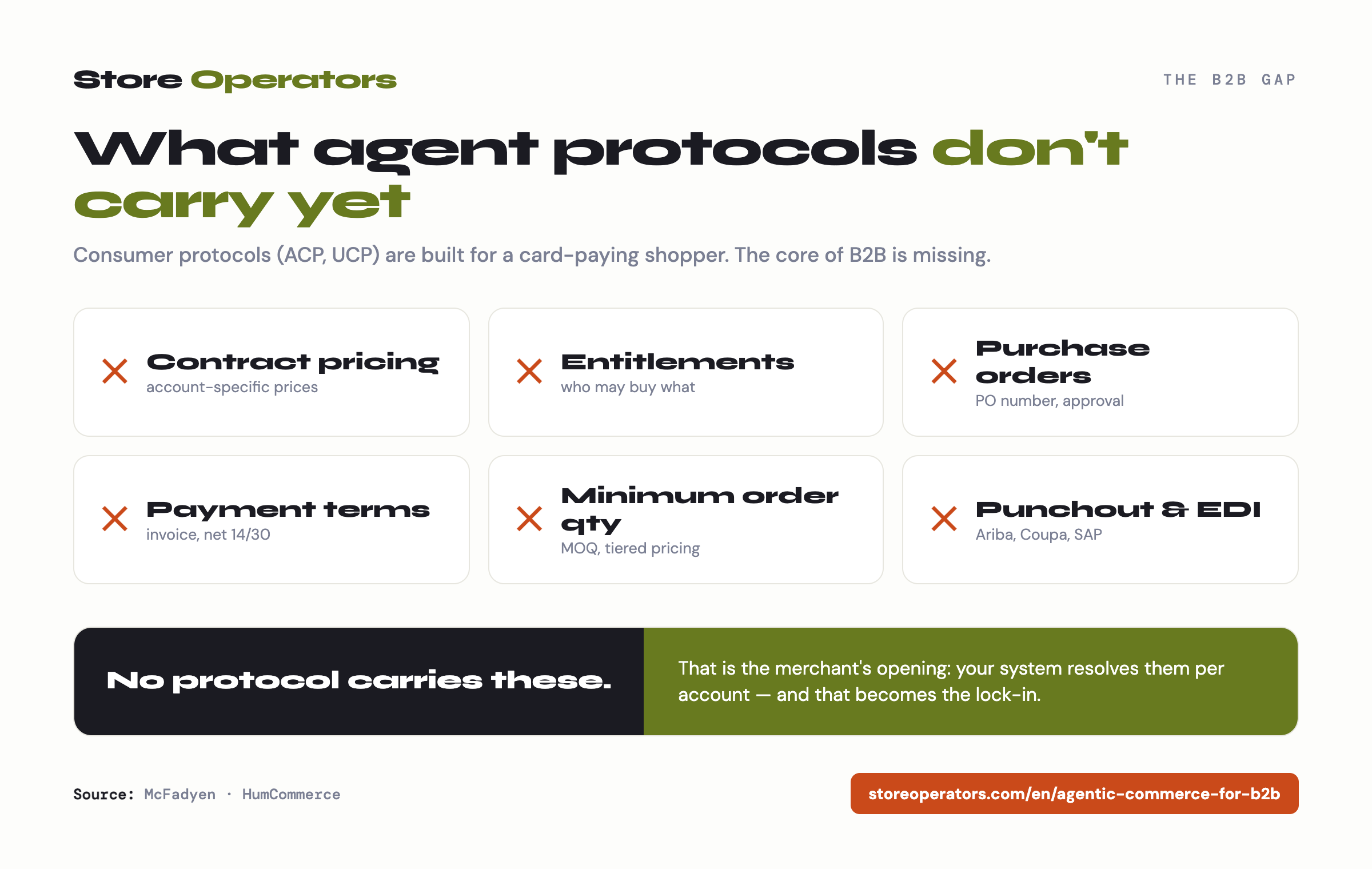
Here is the key point: no agent protocol carries these today. MCP, OpenAI's ACP feed, and the consumer protocols have no representation of account-specific contract pricing, entitlements, approval chains, POs, payment terms, or punchout and EDI links (McFadyen; HumCommerce). Yet these decide who may buy what, at what price, and on whose authority.
The old B2B plumbing is still standing. Most business orders go through punchout catalogs (cXML): the buyer punches out from their procurement system (Ariba, Coupa, SAP) into the supplier's catalog, builds a cart, and the cart returns to the buyer's system for approval. This does not disappear soon. The buy-side platforms are adding agents on top: SAP Ariba (Joule agents), Coupa (Navi, over 450 customers running agents in production), Amazon Business (Business Assistant, November 2025).
The takeaway: because no protocol carries contract price or entitlements, the value is in your system resolving them per account. Offer an authenticated per-account price and entitlement endpoint (an MCP tool or punchout) instead of trusting a public storefront to get a customer's real price right.
The protocols and payment rails, without the confusion
Three camps are forming, and mixing them up is the most common mistake.
MCP (Model Context Protocol) is the transport layer, the "USB-C for AI." Anthropic opened it in November 2024, and OpenAI, Google, and others now support it. ChatGPT has supported custom connectors (MCP) since September 2025, and all four business assistants (ChatGPT Business/Enterprise, Microsoft Copilot, Google Gemini Enterprise, Claude for Work) now speak MCP. So one well-built MCP endpoint is your way into every buyer's assistant.
ACP (Agentic Commerce Protocol) = OpenAI + Stripe. Released 29 Sep 2025, open. The merchant pushes a feed, products are not crawled. One important turn: OpenAI pulled back from in-chat Instant Checkout around March 2026 (CNBC, 20 Mar 2026). The current model is that products show in ChatGPT but the purchase completes on the merchant's own site. That actually strengthens the merchant-hosted model.
UCP (Universal Commerce Protocol) = Google + Shopify (not OpenAI), announced 11 Jan 2026. It publishes a discovery manifest at /.well-known/ucp and runs commerce over REST, MCP, or A2A.
AP2 (Agent Payments Protocol) = Google plus 60-odd partners (Mastercard, Amex, PayPal). Signed mandates prove the agent had authorization.
EU regulation is the hard constraint here. In the EU, agent payments stay fully inside PSD2 and SCA, with no special carve-out for agents (Taylor Wessing, February 2026). In practice a fully autonomous agent payment has no lawful SCA path of its own, so each purchase is bound to a human's strong authentication. The safest path today is merchant-hosted checkout, where the customer completes payment on the store's own checkout with familiar SCA. For a European merchant this matters: the EU-native payment rail is being built on Google's UCP and AP2 through Nexi and Paytrail, not OpenAI and Stripe's ACP. So line your roadmap up with the protocol your own payment provider picks.
The platform picture in 2026
Shopify is furthest ahead: UCP (co-authored with Google), a Storefront MCP on every store, and a Catalog MCP. Agentic Storefronts were on by default for eligible US stores from around March 2026. Native B2B-catalog agent support is uncertain. WooCommerce got native MCP (the WordPress Abilities API) from around version 10.3, developer preview in late 2025. Adobe Commerce (Magento) is the strongest for B2B specifically: Commerce MCP, a Catalog Agent, and B2B building blocks (company accounts, negotiable quotes, requisition lists, purchase orders) framed for procurement agents. BigCommerce leans on data enrichment (Feedonomics).
The takeaway: on Shopify discoverability comes largely by default, on Woo you switch MCP on, and for genuine B2B agent flows Adobe Commerce is currently the most complete.
Data is the moat, and there is evidence for it
The line "an agent is only as good as its data" is the industry consensus, but it is not a verified vendor quote, so we won't present it as one. The defensible form: agents read the structured layer (the feed and catalog data), not the rendered page, and there is support for this.
Princeton's GEO study (Aggarwal et al., arXiv 2023, SIGKDD 2024) showed that adding sources, citations, and statistics can raise a source's visibility in generative answers by up to about 40%, and the lowest-ranked pages gained the most. An ecommerce-focused testbed, E-GEO (arXiv 2025, 13,747 product queries, five engines), found a stable, domain-agnostic optimization pattern. And in B2B the agent filters suppliers against very specific specs and drops products with incomplete attributes before a human sees the list.
The takeaway: the moat is real and defensible. The levers are attribute completeness, clean pricing, availability, and third-party reviews.
The merchant's playbook
Here is what a B2B store should actually do, in order.
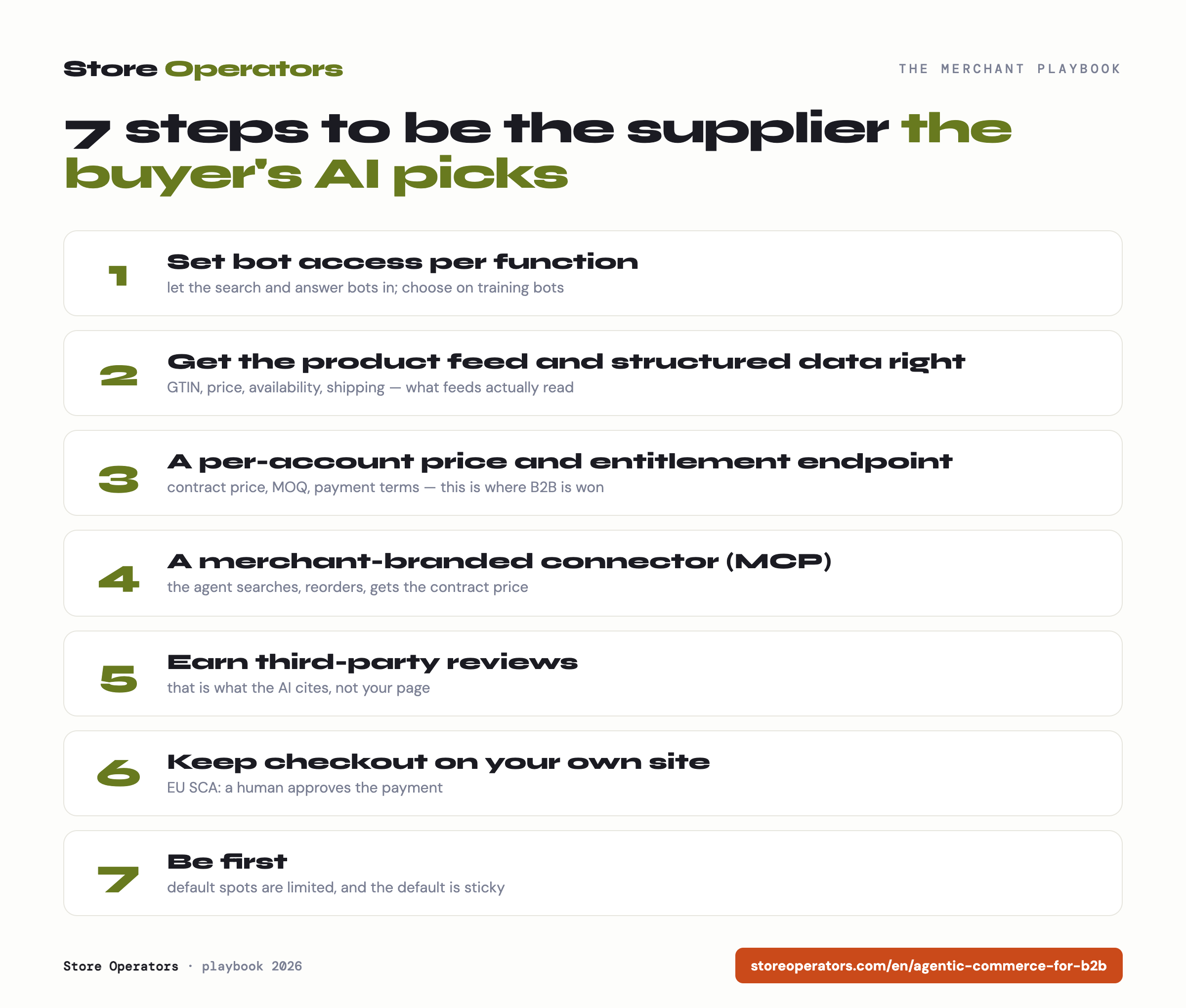
1. Make bot decisions per function. Let the search and answer bots (OAI-SearchBot, Claude-SearchBot, PerplexityBot) in, so you show in answers. Choose separately on the training bots.
2. Get the product feed and structured data right. Mark up Product and Offer: GTIN/MPN, price and currency, availability, shipping and return policy. Keep the feed fresh. This is what feeds and parsers actually use.
3. Resolve the B2B specifics in your own system. Offer an authenticated per-account endpoint that returns the right contract price, entitlements, minimum order quantities, and payment terms. You can mark up eligibleCustomerType and VAT-exclusive pricing as hygiene, but do not expect any 2026 shopping surface to render them. The real B2B channel is your platform's catalog, MCP, and quote flow.
4. Give the buyer a connector their AI can use. Not a link to your site, but a merchant-branded MCP where the agent searches, reorders, gets the contract price, and places a spec-based order.
5. Earn third-party coverage. Reviews and independent media are what the AI cites. It is not your page, it is what others say about your page.
6. Keep checkout on your own site (for now). Because of EU SCA, the safest agent purchase completes on the store's own checkout, where a human approves the payment with strong authentication. Do not design a flow where the agent pays with no human SCA. It is not PSD2-compliant.
7. Be first. Default spots are limited, and in B2B the default is sticky. Once a buyer's system is built on you, they do not switch on a whim.
Where this leaves a white space
AI-visibility tools are mostly brand-level: they measure mentions and citations across ChatGPT, Perplexity, and Gemini. The category is already large and funded (Profound raised 180 million dollars at a 1.8 billion valuation in September 2026). But almost all of them measure the brand, not the product page. Per-SKU AI-citation and structured-data readiness auditing at catalog scale is thin, and B2B supplier AI visibility is essentially open space.
That is where we work. We build the data layer and the connector that a buyer's AI builds its own procurement on, for B2B stores. Ads were the last distribution channel. The next one is being the supplier the machines find on their own.
If you want to see where your store stands now, run the free AI-readiness scan or book a B2B mapping session: storeoperators.com/en/agentic-commerce-for-b2b.
Sources
- OpenAI, Ads in ChatGPT / Testing ads in ChatGPT; TechCrunch 9 Feb 2026
- Gartner, Top Strategic Predictions for 2026 and Beyond (21 Oct 2025), via DigitalCommerce360 28 Nov 2025
- McKinsey agentic commerce forecast, via DigitalCommerce360 20 Oct 2025
- Adobe holiday shopping 2025 / AI referral traffic (January 2026); Salesforce Cyber Week 2025 (5 Dec 2025)
- Pew Research, AI Overviews and clicks (July 2025); Similarweb 2025; Semrush AI Mode (September 2025)
- OpenAI bots (developers.openai.com); Anthropic crawlers (support.claude.com); Google AI features
- Cloro, AI shopping study (May to September 2026)
- schema.org (eligibleCustomerType, UnitPriceSpecification); Google merchant listing; OpenAI ACP feed spec
- ACP: OpenAI + Stripe (29 Sep 2025); UCP: Google + Shopify (11 Jan 2026); AP2: Google (16 Sep 2025); CNBC 20 Mar 2026 (Instant Checkout pullback)
- McFadyen, B2B agentic commerce; HumCommerce contract pricing
- SAP Ariba (Joule), Coupa (Navi), Amazon Business Assistant (November 2025)
- Princeton GEO (arXiv 2311.09735); E-GEO (arXiv 2511.20867)
- Profound Series D (GlobeNewswire 15 Sep 2026)
- EU: Taylor Wessing (February 2026); Nexi + Google Cloud (3 Mar 2026); Paytrail agentic commerce
What does your store look like to AI?
Run the same scan on your own store — 30 seconds, no signup, works on every platform.
Scan your store free